
Why do I write? No, better yet, why do I write poetry? Years ago, I wrote a poem, now lost in some digital cloud somewhere in the ether, where I tried to comedically define it. In the poem, the speaker asks his brother to define for him what poetry is:
“¿Qué es la poesía para ti? / Una Benedecita a las tres de la tarde.”
“What is poetry for you? / A Benedicta beer at 3 p.m.”
I tried to compare the small-individual-lifting joy of poetry to the drinking of a cheap cold beer at the time when the oppressive Caribbean heat tames down.
Poetry has been in my life since before my birth. The proof resides in my first ever photo album where a handful of poems reside, in a special pocket towards the end of it, singing praises about my soon to be birth. My father’s quatrain verses filled the now beige pages with the lyrical songs of a newly minted father.
Also, I found out recently that my grandfather, on my father’s side, was a poet and wrote under the pen name Old Oak:
“Y te miré a los ojos profundamente bellos./ Y sufrí tu mirada clavárseme muy honda,/ y te sentí ondulante, de los pies a los cabellos,/ así como una serpiente, así como una onda.”
“And I looked into your deeply beautiful eyes./ And I felt your gaze pierce me deeply,/ and I felt you undulating, from your feet to your hair,/ just like a serpent, just like a wave.”
Plus, he was an editor and publisher of his hometown’s newspaper. I found this out because my wife is obsessed with our family tree, and in her infinite research, she found a newspaper from the mid-twentieth century where my grandfather’s name was all over the place.
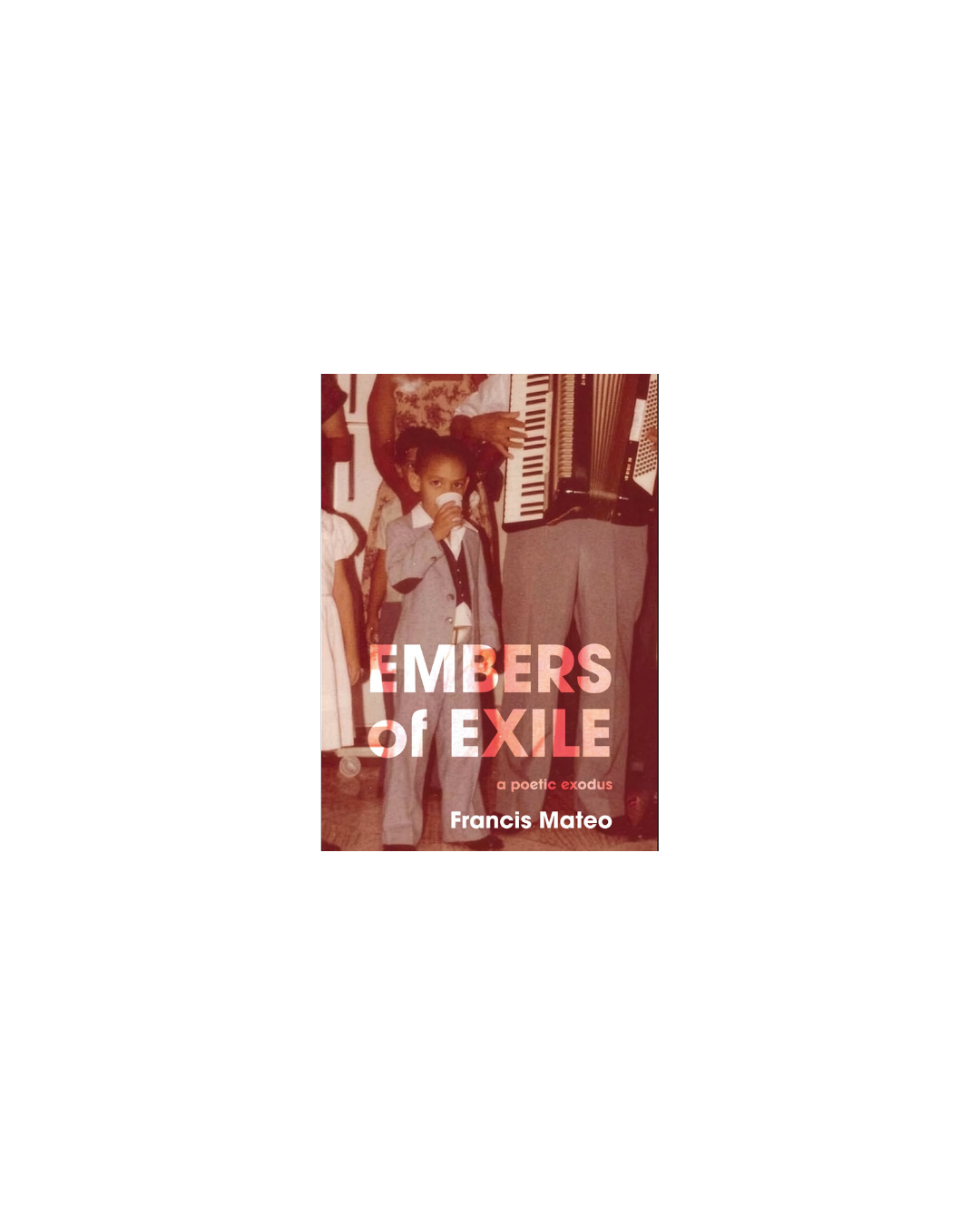
Now, why did I write Embers of Exile and why in English? I can’t help but go back a few years when an established poet told me I should stop writing poetry in Spanish because I was not a good poet, but it was a good thing for me because it would keep me far from joining a gang or heavy drugs. After that heart-to-heart conversation in which I just nodded all the way to the closest bar, I spent a few days on stand-by. After those events took place, meeting and reading the work of Josefina Baez acted as a grounding rock.
The idea to write Embers of Exile sprang from an event that happened on the corner of Dyckman and Post. A man singing way off key, dragging his right leg as if it were a dead fish. In those days, I finished reading Philoctetes by Sophocles, and I could not stop thinking about the similarities between this man and Philoctetes. That night I grabbed a copy of Derek Walcott’s Omeros. I read the first three verses, closed the book, and started writing.
When I finished the first draft, I let the manuscript sit for a while and decided to find a person who could tell me if it made sense. Angy Abreu from Dominican Writers suggested I should talk to Yamberlie Tavarez for the job. I am thankful I did. During that time, I came across a book of poetry called Cannibal by Safiya Sinclair; I read it, and I felt that the book I was writing was not good. I told all this to Yamberlie, plus that I was going to erase the manuscript and begin again. She calmly said, “No, that’s insane. This book is good.” She helped me sharpen my vision and made me stay on track. So, like Philoctetes, I grabbed a hold of my leg, the bow, and arch and walked straight to Troy.
Fast-forward to the year 2026. Get Fresh Book will publish Embers of Exile on July 15th. My grandfather wrote about the legendary mystic and sage Hermes Trismegistus in his poetry, while my father, in his quatrain verse, explored the celebration of life’s cycle. I like to think of Embers of Exile as both a continuation and the sum of this legacy.
I can’t wait for you to read it.
 Francis Mateo is an actor and writer.
https://www.francismateoactor.com/